Tuesday, July 31, 2007

RemoteIterator, episode 2

Last time, I lamented the lack of a standard RemoteIterator interface in Java. I went on to show a version that showed up not long ago in Jackrabbit (an implementation of JSR 170) and the version I've recreated several times in the past. Let's take a quick look at them again.

Jackrabbit's:

public interface RemoteIterator extends Remote {

long getSize() throws RemoteException;

void skip(long items) throws NoSuchElementException, RemoteException;

Object[] nextObjects() throws IllegalArgumentException, RemoteException;

}

The RemoteIterator interface I've recreated a number of times over the years:

public interface RemoteIterator<T> extends Remote {

public boolean hasMore() throws RemoteException;

public List<T> next( int preferredBatchSize ) throws RemoteException;

}

Let's go through the methods individually:

  • long getSize() throws RemoteException

    This seems problematic to me. Perhaps in Jackrabbit, it is reasonable to assume that you will always know the size of the collection to be iterated. But in many situations, this is not the case. For example, if the iterator is ultimately coming from a database cursor and the collection is large, we want to avoid having to run two SQL queries or store the entire collection in memory (which may be prohibitively expensive). I can see a derived interface, perhaps named BoundedRemoteIterator or something, but not in this interface.

  • void skip(long items) throws NoSuchElementException, RemoteException

    I love this idea. Wish I'd thought of it myself. A trivial implementation would do whatever next( items ), would do and simply not return the items. A smart implementation can save time and space by not actually generating the objects (since they won't be returned). The only change I would make is to have a return value of the number of items skipped and get rid of the NoSuchElementException. If I ask to skip 50 items and only 29 more exist, I would get a return of 29 and no exception. Admittedly, if the interface included a getSize operation, throwing NoSuchElementException is less strange. But even in that case, it seems too rigid to consider skipping more items than are left an 'exception'.

  • boolean hasMore() throws RemoteException

    At first, you might think this is a wasteful operation. Why make a call to find out if there are more items? This results in 'extra' remote calls instead of simply asking for the next item. However, if we imagine the items themselves as quite large (e.g. multi-megapixel images), we start to see a use for this API. If we were keeping the getSize operation, this might not be necessary, but again, getSize() requires state tracking on the client side that can substantially complicate the client code.

  • Object[] nextObjects() throws IllegalArgumentException, RemoteException

    This is similar to my next operation discussed below, except (1) it throws IllegalArgumentException, (2) returns an array of objects instead of a List of a specific type, and (3) does not take a preferred size.

    (1) I'm guessing that the getSize operation is intended to be called and then the caller is expected to know when all items in the iterator are consumed. This creates a problem if the client consumes different parts of the iterator in different parts of the code. Now, they have to pass around 2 or 3 items (remote iterator, number of items consumed so far, and possibly the total size) to do this. This is clunky to say the least.

    (2) Jackrabbit may have been specified before 1.5 was in wide use, or may feel the need for backward compatibility, hence the use of an array of Object. The downside to this is the loss of type-safety and loss of an API that can be optimized. See the discussion of next below.

    (3) See the discussion of next below for the rationale for a preferred batch size.

  • List<T> next( int preferredBatchSize ) throws RemoteException

    By returning a List<T>, we not only introduce type information/safety, we also allow for further optimization. The List returned could be a simple implementation such as LinkedList or ArrayList. Or, it could be a smart List that collaborates with the RemoteIterator to delay retrieving its contents or retrieve the contents in separate threads. There are lots of possibilities introduced by avoiding raw Java arrays.

    Allowing the client to pass a preferred batch size provides many optimization opportunities. For example, if displaying the items in a GUI, they can ask for 'page-sized' numbers of items. By making the preferred size a suggestion, it allows an implementation leeway to ignore requests that are deemed unmanageably small or large for the kind of information being returned.


So, where does this leave us? Our RemoteIterator now looks like this:

import java.rmi.Remote;
import java.rmi.RemoteException;
import java.util.List;

/**
* Interface for a remote iterator that returns entries of a particular type.
* @see java.util.Iterator
* @see java.rmi.Remote
*/
public interface RemoteIterator<T> extends Remote {

/**
* Determine if there are more items to be iterated across
* @return true if there are more items to be
* iterated, false otherwise.
* @throws RemoteException if a problem occurs with
* communication or on the remote server.
*/
boolean hasMore() throws RemoteException;

/**
* Skip some number of items.
* @param items the number of items to skip at maximum. If there are fewer
* items than this left, all remaining items are skipped.
* @return the number of itmes actually skipped. This will equal <code>items</code>
* unless there were not that many items left in the iteration.
* @throws RemoteException if a problem occurs with
* communication or on the remote server.
*/
int skip(long items) throws RemoteException;

/**
* Get some number of items
* @param preferredBatchSize a suggested number of items to return. The implementation
* is not required to honor this request if it will prove too difficult.
* @return a List of the next items in the iteration, in iteration order.
* @throws RemoteException if a problem occurs with
* communication or on the remote server.
*/
List<T> next( int preferredBatchSize ) throws RemoteException;

}


I'm still wondering why this isn't part of the JDK.

Thursday, July 19, 2007

RemoteIterator, where art thou?

I've written my fair share of remote iterators over the years. The concept is simple enough: provide an interface for iterating over a set of items that come from a remote source. The harder part is making a good abstraction that can still perform well.

Even so, it surprises me that, as far as I can tell, there hasn't been a standardized form of this. There's been discussion for a long time, with my earliest memories stemming from the JINI mailing lists back in 2001. Yet there's nothing in the core as of Java 6. There are random postings on various groups on the subject through the years, but no actual API that I can find.

Recently, I was teaching my course in Java performance tuning and discussing remote iterators, when a student mentioned that Jackrabbit (an implementation of JSR 170) has an RMI remoting API called Jackrabbit JCR-RMI which includes a RemoteIterator. As of version 1.0.1, it looks like this:

public interface RemoteIterator extends Remote {

long getSize() throws RemoteException;

void skip(long items) throws NoSuchElementException, RemoteException;

Object[] nextObjects() throws IllegalArgumentException, RemoteException;

}

Here is the RemoteIterator interface I've recreated a number of times over the years:

public interface RemoteIterator extends Remote {

public boolean hasMore() throws RemoteException;

public List next( int preferredBatchSize ) throws RemoteException;

}

These two APIs are strikingly similar. They both extend Remote, they both provide a means to get some number of the next items to be retrieved (mine with generics and theirs without), and they are both quite small. Yet they are also strikingly different: JackRabbit's API has both getSize and skip while mine doesn't.

Next time, I'll describe what I see as the major differences and what I like about each. I'll also compare the client-side front-end for remote iterators from Jackrabbit and the one I've created. In the mean time, consider it a challenge to comment about everything I was going to bring up and more.

Monday, July 02, 2007

Random Acts of Blog

I've been subscribed to Brian Coyner's blog for some time. I had this URL:

feed://beanman.wordpress.com/atom.xml

Recently, I was quite surprised when Brian seemed to stop blogging about software and began blogging about bands I had no idea he liked. But I chalked it up to a sudden burst of music interest.

Then, today, I tried to go to his blog and got this:


It turns out to be a blog feed for People Magazine's StyleWatch. WTF? A bit of digging and it would seem that the feed above no longer works. But instead of giving me an error, I'm directed to a random wordpress.com blog page instead. Talk about non-intuitive!

Freaky....

Thursday, June 28, 2007

Friday Java Quiz

My friend, Weiqi Gao, frequently posts a Friday Java Quiz . I ran into a situation today that seems like a good one.

Suppose you have the following two classes:

public class Test {
public static void main(String[] args) {
System.err.println( Foo.class.getName() );
System.err.println( "Testing, 1, 2, 3..." );
new Foo();
}
}

public class Foo {
static {
System.err.println( "Foo here." );
}
public Foo() {
System.err.println( "New Foo!" );
}
}


Without running this program, do you know what the output will be?

Thursday, May 17, 2007

Kyle Cordes on tools

Kyle Cordes wants people to view a presentation by Linus Torvalds discussing distributed version control tools. I plan to watch the talk soon, but a comment Kyle made in his blog entry really rang true. It's something I've been saying (less eloquently) for a long time:

"I have heard it said that these are all 'just tools' which don’t matter, you simply use whatever the local management felt like buying. That is wrong: making better tool choices will make your project better (cheaper, faster, more fun, etc.), making worse tool choices will make your project worse (more expensive, slower, painful, higher turnover, etc.)"

Friday, April 06, 2007

I've been tagged

There is apparently a blog-tag game going around, and Jeff Brown tagged me.


  1. I practice Yang-style short form T'ai Chi Ch'uan.

  2. I've been having fun lately making home-made no knead bread.

  3. I enjoy woodworking. I'm currently tuning my latest large tool purchase. It took me about a year to save enough to get my bandsaw. I even build things.

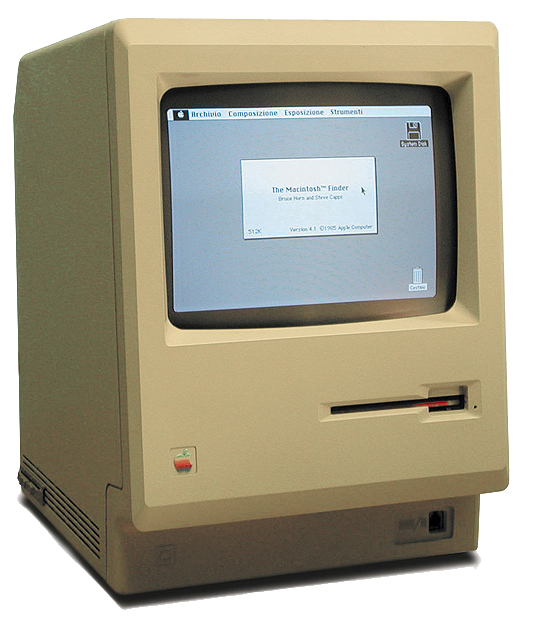
  4. I've used a Mac since the original 128k version introduced in 1984.

  5. Perhaps because I didn't drink much as a teenager, I never developed a taste for beer. I do enjoy single malt scotch.


Now I'm tagging Weiqi, Brad, Dave, Brian, and Melben.

Tuesday, March 20, 2007

Too much C++

(with apologies to Monty Python)

A customer enters a software shop.

Mr. Praline: 'Ello, I wish to register a complaint.

The owner does not respond.

Mr. Praline: 'Ello, Miss?

Owner: What do you mean "miss"?

Mr. Praline: I'm sorry, I have a cold. I wish to make a complaint!

Owner: We're closin' for lunch.

Mr. Praline: Never mind that, my lad. I wish to complain about this programming language what I purchased not half an hour ago from this very boutique.

Owner: Oh yes, the, uh, the Danish C++...What's,uh...What's wrong with it?

Mr. Praline: I'll tell you what's wrong with it, my lad. 'E's crap, that's what's wrong with it!

Owner: No, no, 'e's uh,...it's resting.

Mr. Praline: Look, matey, I know a crap language when I see one, and I'm looking at one right now.

Owner: No no it's not crap, it's, it's restin'! Remarkable language, the Danish C++, idn'it, ay? Beautiful syntax!

Mr. Praline: The syntax don't enter into it. It's stone crap.

Owner: Nononono, no, no! 'E's resting!

Mr. Praline: All right then, if it's restin', I'll wake him up! (shouting at the cage) 'Ello, Mister Plymorphic Language! I've got a lovely fresh computer for you if you show...

owner hits the cage

Owner: There, he moved!

Mr. Praline: No, he didn't, that was you hitting the cage!

Owner: I never!!

Mr. Praline: Yes, you did!

Owner: I never, never did anything...

Mr. Praline: (yelling and hitting the cage repeatedly) 'ELLO POLYMORPH!!!!! Testing! Testing! Testing! Testing! This is your nine o'clock alarm call!

Takes language out of the cage and thumps its head on the counter. Throws it up in the air and watches it plummet to the floor.

Mr. Praline: Now that's what I call a crap language.

Owner: No, no.....No, 'e's stunned!

Mr. Praline: STUNNED?!?

Owner: Yeah! You stunned him, just as he was wakin' up! Danish C++'s stun easily, major.

Mr. Praline: Um...now look...now look, mate, I've definitely 'ad enough of this. That language is definitely deceased, and when I purchased it not 'alf an hour ago, you assured me that its total lack of movement was due to it bein' tired and shagged out following a prolonged standards meeting.

Owner: Well, it's...it's, ah...probably pining for a common runtime.

Mr. Praline: PININ' for a COMMON RUNTIME?!?!?!? What kind of talk is that?, look, why did he fall flat on his back the moment I got 'im home?

Owner: The Danish C++ prefers keepin' on it's back! Remarkable language, id'nit, squire? Lovely syntax!

Mr. Praline: Look, I took the liberty of examining that language when I got it home, and I discovered the only reason that it had been sitting on its perch in the first place was that it had been NAILED there.

pause

Owner: Well, o'course it was nailed there! If I hadn't nailed that language down, it would have nuzzled up to those computers, broke 'em apart with its beak, and VOOM! Feeweeweewee!

Mr. Praline: "VOOM"?!? Mate, this language wouldn't "voom" if you put four million volts through it! 'E's bleedin' demised!

Owner: No no! 'E's pining!

Mr. Praline: 'E's not pinin'! 'E's passed on! This language is no more! He has ceased to be! 'E's expired and gone to meet 'is maker! 'E's a stiff! Bereft of life, 'e rests in peace! If you hadn't nailed 'im to the perch 'e'd be pushing up the daisies! 'Is processes are now 'istory! 'E's off the map! 'E's kicked the bucket, 'e's shuffled off 'is mortal coil, run down the curtain and joined the bleedin' choir invisibile!! THIS IS AN EX-LANGUAGE!!

pause

Owner: Well, I'd better replace it, then. (he takes a quick peek behind the counter) Sorry squire, I've had a look 'round the back of the shop, and uh, we're right out of languages.

Mr. Praline: I see. I see, I get the picture.

Owner: I got Java.

pause

Mr. Praline: Pray, does it support pointers?

Owner: Nnnnot really.

Mr. Praline: WELL IT'S HARDLY A BLOODY REPLACEMENT, IS IT?!!???!!?

Owner: N-no, I guess not. (gets ashamed, looks at his feet)

Mr. Praline: Well.

pause

Owner: (quietly) D'you.... d'you want to come back to my place an' dereference some pointers?

Mr. Praline: (looks around) Yeah, all right, sure.

Thursday, March 15, 2007

The ever-leaky abstractions of Microsoft

I was using Windows XP inside Parallels today and got a message from Windows that I had never seen before:


How on earth could you design an operating system that could detect there wasn't enough virtual memory, expand the virtual memory pool automatically, but would deny applications requests for virtual memory at the same time?

Thursday, March 01, 2007

C++ Unit testing frameworks: do they all suck?

Well, I've been doing some work with C++ lately and I quickly ran into the need for a unit testing framework. I found an excellent article reviewing the state of C++ unit testing frameworks. My first surprise was how many of them there are. This article alone reviewed six of them. Even if those are all of the 'serious contenders', that's about 3 or 4 frameworks too many.

I was also surprised at how primitive the C++ unit testing frameworks feel. I realized after a while that the lack of dynamic/reflective behavior in C++ is part (or even all) of the issue. Since reflection is not built in, many of the grungy tasks that unit testing frameworks in Java automate for us can't be automated in a C++ unit testing framework. What a shame. We're left using frameworks that feel awkard and leave a lot to be desired.

Then I got to thinking: a number of the C++ wizards around here talk about the power of C++ template programming. It seems to me it ought to be possible to clean up and automate what would normally be done in Java with reflection using templates in C++. I wonder why this hasn't been done. I don't know templates well enough to do it myself, but I hope some wiz at C++ templates does this sometime soon.

For now, I'll keep trudging along with CppUnit, and maybe try out CxxTest.

Thursday, February 01, 2007

Adding a JNI Library template to Xcode

I've been doing some work with Xcode, Apple's IDE, recently. I wanted to use it for doing Java JNI work, since I'm doing some of that, but found the normal tutorial assumes you are building an entire application with Xcode. Well, Xcode pales in comparison to IDEA for working with Java.

So I wondered if I could use IDEA for working with the Java code and Xcode for managing the JNI bindings and the C++ code that goes with it. After a bit of playing around (primarily pulling bits and pieces from Apple's mini-tutorial on JNI with Xcode), I figured out how to build a JNI library that I can use easily from IDEA.

That got me to thinking about the four or five steps I would have to do each time I created a new one of these projects (which I expect to be doing for a while). I vaguely remembered a friend talking about customizing Xcode by creating new templates. So I set out to create one for building JNI libraries.

I googled around a bit and found out that Xcode keeps its templates in:

/Library/Application Support/Apple/Developer Tools

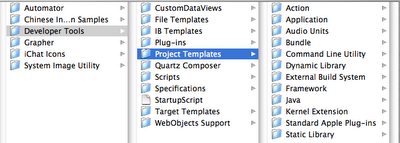
Looking there, I see a folder called "Project Templates", and sure enough inside are all the templates for Xcode projects.

There are several that look promising, but what's the difference between a "BSD Dynamic Library", a "C++ Dynamic Library", and a "C++ Standard Dynamic Library"? Something based on the "C++ Standard Dynamic Library" seems right.

So, I create a test project and make a few changes to produce a JNI library:
  • Change "Executable Extension" to be "jnilib"
  • Change "Header Search Paths" to include "$(SDK)/System/Library/Frameworks/JavaVM.framework/Headers"
  • Delete the Carbon framework (why was it there in the first place?)

Now, save the project, make sure it builds (which it does) and create a simple Java HelloWorld with a native method that calls our Test class.

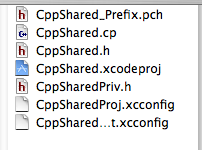
Having verified that this sort of project can be used to produce a JNI Library, it's time to create the custom project template. First I copy the "C++ Standard Dynamic Library template" to "JNI C++ Standard Dynamic Library". Now I need to find the right places to insert the additional items that were changed (and how to remove the Carbon framework). Looking at the template directory, I see a number of files. But most of these are just boilerplate for source files in the project ('.pch', '.h', '.cp'). I think I can safely ignore these files at least for now (though I made note of them; if there prove to be certain common files in my JNI libraries moving forward, I can come back and try to tweak the project template to have different boilerplates).

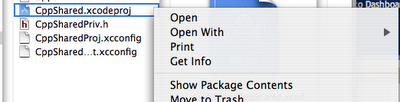
The key 'file' appears to be CppShared.xcodeproj. Right-clicking on it shows it is really a 'package' and I take a look inside.


When I do so, I see two files: "TemplateInfo.plist" and "project.pbxproj". The '.plist' file has some interesting items about template files and lists of files upon which to perform macro expansion. Interestingly, the list of files matches the list of boilerplate files almost exactly. For now, I'm leaving these alone (again making note in case I want to change the set of boilerplate files in the project). There is also a Description item, which shows up in the "New Project..." window in Xcode. After tweaking that to make it better describe this new kind of project I'm creating, I move on to the "project.pbxproj" file.

The "project.pbxproj" file is semi-text and semi-binary. So it's time to be careful and make a backup before experimenting. The first section of interest is this:

/* Begin PBXFileReference section */
08FB77AAFE841565C02AAC07 /* Carbon.framework */ = {isa = ...
32BAE0B70371A74B00C91783 /* «PROJECTNAME»_Prefix.pch */ = {isa = ...
50149BD909E781A5002DEE6A /* «PROJECTNAME».h */ = {isa = ...
5073E0C409E734A800EC74B6 /* «PROJECTNAME».cp */ = {isa = ...
5073E0C609E734A800EC74B6 /* «PROJECTNAME»Proj.xcconfig */ = {isa = ...
5073E0C709E734A800EC74B6 /* «PROJECTNAME»Target.xcconfig */ = {isa = ...
50B2938909F016FC00694E55 /* «PROJECTNAME»Priv.h */ = {isa = ...
D2AAC09D05546B4700DB518D /* lib«PROJECTNAME».dylib */ = {isa =
PBXFileReference; explicitFileType = "compiled.mach-o.dylib";
includeInIndex = 0; path = "lib«PROJECTNAME».dylib"; sourceTree = BUILT_PRODUCTS_DIR; };
/* End PBXFileReference section */

I ditch the Carbon framework reference (since I'm doing JNI) by deleting the line that references Carbon. If I want to use Carbon in a JNI library, I can always add it later. It turns out there are a bunch of other references to Carbon in the template, and I have to remove those as well.

Now, I see the line that makes reference to "lib«PROJECTNAME».dylib". I want the library to end with '.jnilib' since that is required by Mac OS X. So I patch this:

D2AAC09D05546B4700DB518D /* lib«PROJECTNAME».jnilib */ = {isa =
PBXFileReference; explicitFileType = "compiled.mach-o.dylib";
includeInIndex = 0; path = "lib«PROJECTNAME».jnilib"; sourceTree = BUILT_PRODUCTS_DIR; };
/* End PBXFileReference section */

Now, I want the header search paths to include the location of the Java headers, and the executable extension to be '.jnilib'. Searching the test project's '.pbxproj' file, I find them in the Debug and Release build sections. However, there are two pairs of these, one pair for the library target and one pair for the overall project. I need to change the ones for the overall project:

1DEB916508733D950010E9CD /* Debug */ = {
isa = XCBuildConfiguration;
baseConfigurationReference = 5073E0C609E734A800EC74B6 /* «PROJECTNAME»Proj.xcconfig */;
buildSettings = {
COPY_PHASE_STRIP = NO;
DEBUG_INFORMATION_FORMAT = dwarf;
EXECUTABLE_EXTENSION = jnilib;
GCC_ENABLE_FIX_AND_CONTINUE = YES;
GCC_OPTIMIZATION_LEVEL = 0;
HEADER_SEARCH_PATHS = "$(SDK)/System/Library/Frameworks/JavaVM.framework/Headers";
ZERO_LINK = YES;
};
name = Debug;
};
1DEB916608733D950010E9CD /* Release */ = {
isa = XCBuildConfiguration;
baseConfigurationReference = 5073E0C609E734A800EC74B6 /* «PROJECTNAME»Proj.xcconfig */;
buildSettings = {
ARCHS = (
ppc,
i386,
);
DEAD_CODE_STRIPPING = YES;
DEBUG_INFORMATION_FORMAT = "dwarf-with-dsym";
EXECUTABLE_EXTENSION = jnilib;
HEADER_SEARCH_PATHS = "$(SDK)/System/Library/Frameworks/JavaVM.framework/Headers";

PRESERVE_DEAD_CODE_INITS_AND_TERMS = YES;
SEPARATE_STRIP = YES;
};
name = Release;
};

I was encouraged when creating a new project didn't fail. Looking at the default setup, everything seems to be in order (no Carbon framework, all the boilerplate files are there, etc.). A few minutes to add in the JNI binding function and change the Java program to use the new JNI library and I have a successful test.

I'm sure there are many other customizations I could make if I only knew about them. I also wish there were a better tool than a text editor for editing these files (hopefully there is and someone will point it out to me).